


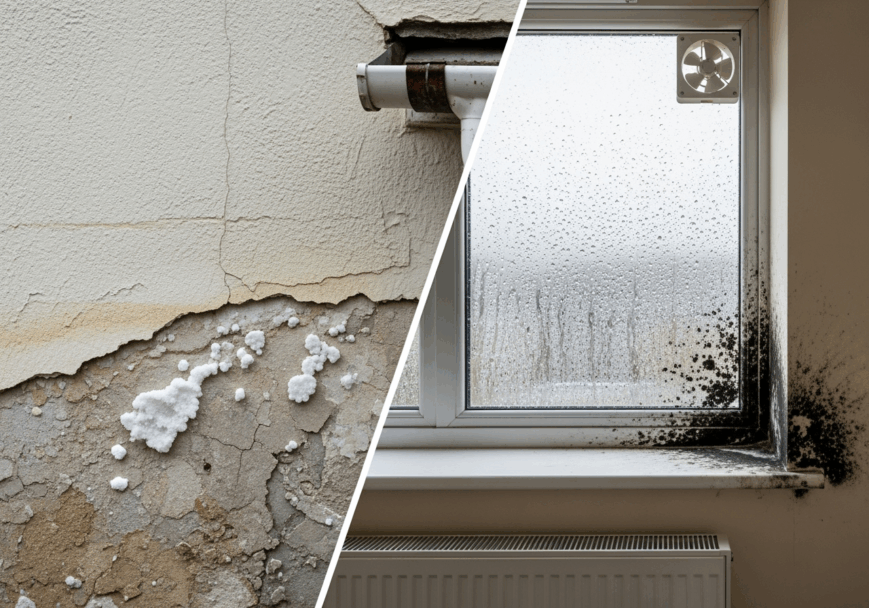
Damp and condensation can look identical on a wall — the same peeling paint, the same black mould, the same musty smell — but they are two different problems with two different fixes. Condensation is moisture from inside the home settling on cold surfaces, usually solved by better ventilation. Damp is water getting in from outside or the ground, which means a building defect that has to be repaired at source. Confuse the two and you can spend a great deal of money solving the wrong problem.
In a home survey, telling them apart is one of the most valuable things a surveyor does, because the difference can be a cheap ventilation fix or a five-figure repair. Here’s how to tell which is which, why it matters, and what to do if a survey finds either in a home you’re buying.
What’s the difference between damp and condensation?
The simplest way to think about it: condensation comes from inside the home, damp comes from outside it. Condensation forms when warm, moisture-laden air — from cooking, showering, drying clothes or simply breathing — meets a cold surface such as a window or an external wall and turns back into water. Damp is the unwanted entry of water into the building from the ground, through the walls or roof, or from a leak.
That single distinction drives everything else. Condensation is usually a ventilation and heating issue you can manage, often without major cost. Damp is a defect in the building’s fabric that needs tracing to its source and repairing. The visible signs overlap, which is exactly why the two get muddled, and why an accurate diagnosis matters far more than a quick label slapped on the problem.
What causes condensation, and how do you spot it?
Condensation is caused by too much moisture in the air, too little ventilation, and cold surfaces for that moisture to settle on. Modern, well-sealed homes with double glazing and fewer draughts can actually make it worse, because the moisture has nowhere to escape.
The signs are distinctive once you know them: water running down windows in the morning, and black, speckled mould in cold corners, behind furniture, around window reveals and on ceilings, usually in the least-ventilated rooms such as bathrooms, kitchens and bedrooms. The tell-tale is that condensation mould tends to appear high up and in cold corners where air doesn’t circulate, rather than as a single wet patch. The fixes are about managing moisture and airflow: extractor fans, trickle vents, drying washing outside, lids on pans, and keeping rooms gently and consistently warm rather than letting them go cold.
What causes damp, and what are the signs?
Damp is caused by water physically entering the building, and it falls into three main types: rising damp, penetrating damp, and leaks from plumbing. Each is a defect rather than a lifestyle issue, and each needs repairing at the source.
The signs differ from condensation. Look for tide marks and staining low on walls, crumbling or blown plaster, white salt deposits, persistent wet patches that never quite dry out, and a musty smell that lingers regardless of ventilation. Unlike condensation, damp won’t be cured by opening a window or running an extractor fan. It needs the cause found and fixed, whether that’s a failed damp-proof course, defective pointing, a slipped roof tile or a leaking pipe.
What’s the difference between rising, penetrating and plumbing damp?
Three different mechanisms, three different remedies. Rising damp is groundwater drawn up through the base of a wall where the damp-proof course is missing, bridged or has failed, and it typically shows as a tide mark up to around a metre from floor level. Penetrating damp is water passing horizontally into the building through defective pointing, cracked render, a failed roof or blocked gutters, and tends to appear as isolated patches on external walls or ceilings, often worse after rain.
Plumbing leaks are exactly what they sound like: escaping water from pipes, waste or heating, frequently hidden, that can mimic either of the other two. Identifying which one you’re dealing with is half the work, because the remedy for each is completely different, and treating one as another wastes money.
How can you tell damp from condensation?
Three things give it away: location, pattern and a moisture meter. Condensation appears high in cold corners, around windows and in poorly ventilated rooms, as speckled black mould. Rising damp shows as a tide mark low down on walls. Penetrating damp shows as a localised patch on an external wall or ceiling, usually linked to a defect outside and worse after heavy rain.
A moisture meter helps confirm the diagnosis, but only in trained hands. Readings can be thrown off by salts in plaster or by surface moisture, which is precisely how condensation gets misdiagnosed as rising damp, and vice versa. When the signs are mixed — as they often are in a real home — it takes experience to read them correctly. That interpretation, rather than the meter itself, is where a thorough surveyor earns their fee.
Why does getting the diagnosis right matter?
Because the wrong diagnosis wastes money and leaves the real problem unsolved. The classic example is a chemical damp-proof course installed to cure what was actually condensation: an expensive treatment that achieves nothing, because the moisture was never coming up from the ground in the first place. It happens the other way too, when genuine penetrating damp is dismissed as a “ventilation problem” and water keeps getting in while the fabric of the building quietly deteriorates.
Rising damp in particular is over-diagnosed across the industry, often by firms who also happen to sell the treatment. An independent surveyor with no remedial product to sell has no reason to find a problem that isn’t there, which is one good argument for getting your diagnosis from someone who only advises.
Is black mould dangerous?
Black mould is worth taking seriously, both because it can affect health — particularly for anyone with asthma, allergies or a weakened immune system — and because it’s a signal that a moisture problem is going unaddressed. It rarely appears without a reason.
The important point is that wiping mould off the wall treats the symptom, not the cause. If the underlying condensation or damp isn’t fixed, it comes back. Identifying the source is what actually solves it, which is why visible mould should prompt a proper look at why the moisture is there, rather than just a tub of mould spray and a fresh coat of paint over the top.
How do surveyors check for damp and condensation?
A surveyor combines a careful visual inspection with moisture readings and an understanding of how the particular building is put together. At Websters, we use professional-grade moisture meters rather than the cheap handheld kind, and our surveyors are trained to interpret the readings rather than be caught out by false positives from wall salts or surface moisture.
We look at the pattern and location of any moisture, the ventilation and heating in the property, the external condition of the walls, roof and gutters, and the age and construction of the building, then report clearly on what we’ve found and what it means. The aim is that you come away knowing whether you’re looking at a simple ventilation fix or a repair that should affect your budget or your offer. This forms part of both our Level 2 HomeBuyer Report and Level 3 Building Survey.
The survey found damp or condensation in a home I’m buying — what now?
Don’t panic, and don’t ignore it. Condensation is common and usually manageable; damp is more likely to need investigation and repair, and can be grounds to renegotiate. The right next step depends on which it is and how serious it proves to be.
If it’s condensation, you’re generally looking at ventilation improvements rather than a reason to pull out. If it’s damp, get the source and likely repair cost established, because a concrete figure is what lets you go back to the seller on solid ground. We’ve set out exactly how to use survey findings to renegotiate, fix, or walk away in this guide.
Thinking about a home survey?
If you’re buying, an accurate read on any damp or condensation now can save you both money and worry later. Websters Surveyors is an RICS-regulated practice carrying out home surveys across London and the surrounding counties, including Hertfordshire, Essex, Surrey, Berkshire and Buckinghamshire, rated 4.9 across more than 300 Google reviews.
Request a quote or call us on 020 8017 1943 for straightforward advice from a surveyor working for you.
Frequently asked questions
How do I know if it’s damp or condensation? Location and pattern are the best guide. Speckled black mould high in cold corners and around windows usually points to condensation. A tide mark low on a wall suggests rising damp, while an isolated patch on an external wall or ceiling that worsens after rain suggests penetrating damp.
Does condensation cause black mould? Yes. Black, speckled mould in cold, poorly ventilated corners is one of the most common signs of condensation. Cleaning it off only treats the symptom; improving ventilation and warmth addresses the cause.
Will opening windows fix damp? No. Ventilation helps with condensation, but damp is water entering the building from outside or the ground and has to be fixed at source, whether that’s a damp-proof course, pointing, the roof or a leaking pipe.
Is rising damp serious, and is it common? Genuine rising damp can be serious but it is also over-diagnosed, often by firms that sell the treatment. Many cases blamed on rising damp turn out to be condensation or penetrating damp, which is why an independent diagnosis matters.
Can a home survey tell the difference between damp and condensation? Yes. A surveyor uses location, pattern, moisture readings and knowledge of the building’s construction to distinguish them, and reports on what each finding means so you can decide what to do before you commit to the purchase.