

A clear, expert survey before you commit RICS Level 2 and Level 3 home surveys
A home survey is an independent inspection of the property you're buying — carried out for you, by an RICS-qualified surveyor, to set out its true condition and the defects worth knowing before you're contractually bound. We offer the RICS Level 2 and Level 3 surveys, with drone roof inspection and a complimentary solicitor's summary included on every survey.

"Buying a home is one of life's biggest decisions. Our reports highlight what matters most — clearly explaining any issues, risks and next steps — so you can negotiate with confidence or buy with peace of mind." Dan Knowles FRICS · Managing Director & RICS Registered Valuer
A home survey is an independent assessment of a property's construction and condition, commissioned by you, for you — not your lender — so you understand exactly what you're buying before you exchange.
We offer two surveys: a Level 2, for a conventional property in reasonable order, and a Level 3, for older, altered, unusual or run-down homes that need a deeper look. (The RICS range also includes a basic Level 1 Condition Report, but very few firms offer it and it rarely suits a home purchase.) Both our surveys are carried out by RICS-qualified surveyors who are also Registered Valuers, and both include drone roof inspection and a complimentary solicitor's summary.
A survey is not the same as your mortgage valuation — that exists to protect the lender, and won't tell you about the property's condition. The job of a survey is to put full information in your hands: what's wrong, what it means, and what to do about it, while you still have room to act on it.
Two levels, so you pay for the right detail
Choose the level that suits the property and your own requirements — and if you're not sure, we'll quote for both and explain the difference.
Level 2 Home Survey
A clear, rated survey for a conventional house, flat or bungalow in reasonable condition — flagging the defects and risks worth knowing, without unnecessary technical detail.
- Conventional homes built from common materials
- Properties in reasonable, well-maintained order
- Newer houses and flats (roughly 1950s onwards)
- Buyers who want the essentials, rated at a glance
Level 3 Home Survey
The most thorough survey in the RICS range — an element-by-element assessment that explains what is wrong, why it has happened, and what to do about it, with repair options and priorities.
- Older, period or listed properties
- Heavily altered, extended or converted homes
- Non-traditional or unusual construction
- Run-down properties, or where there are concerns about particular disrepair that may warrant it
See exactly what you'll receive
Every report complies with the RICS Home Survey Standard. Download a full sample report and see the solicitor's summary that comes with every survey.
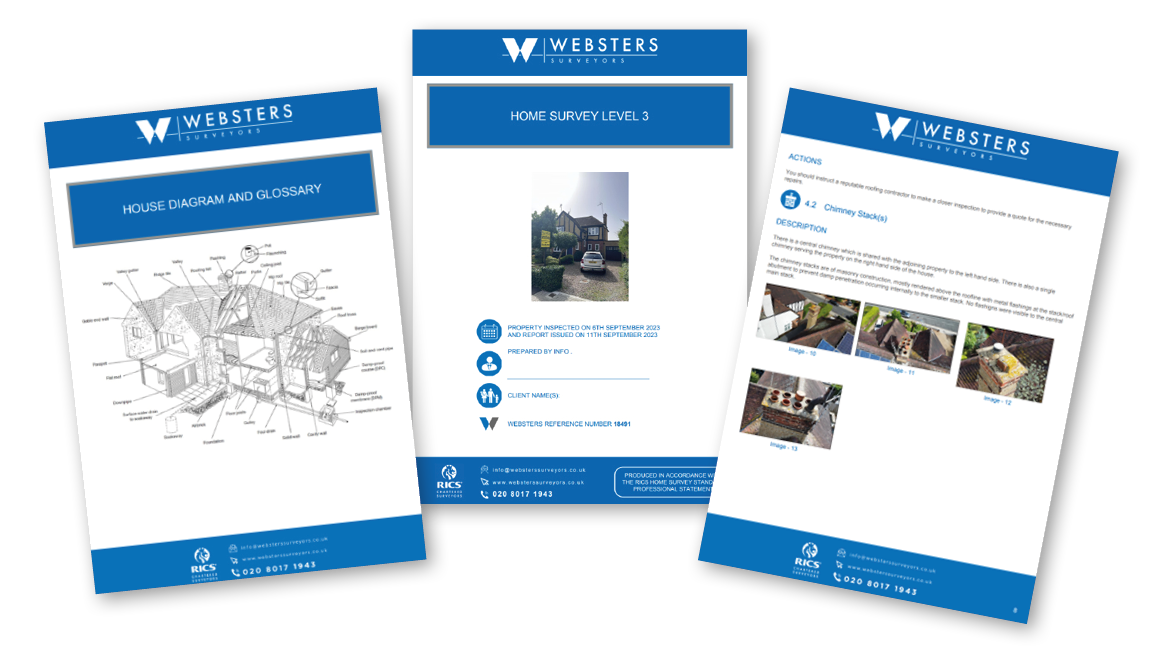
An example of our home survey report
See how we set out condition, defects, repair options and priorities — and what they mean for you, the buyer.
Download sample report (PDF)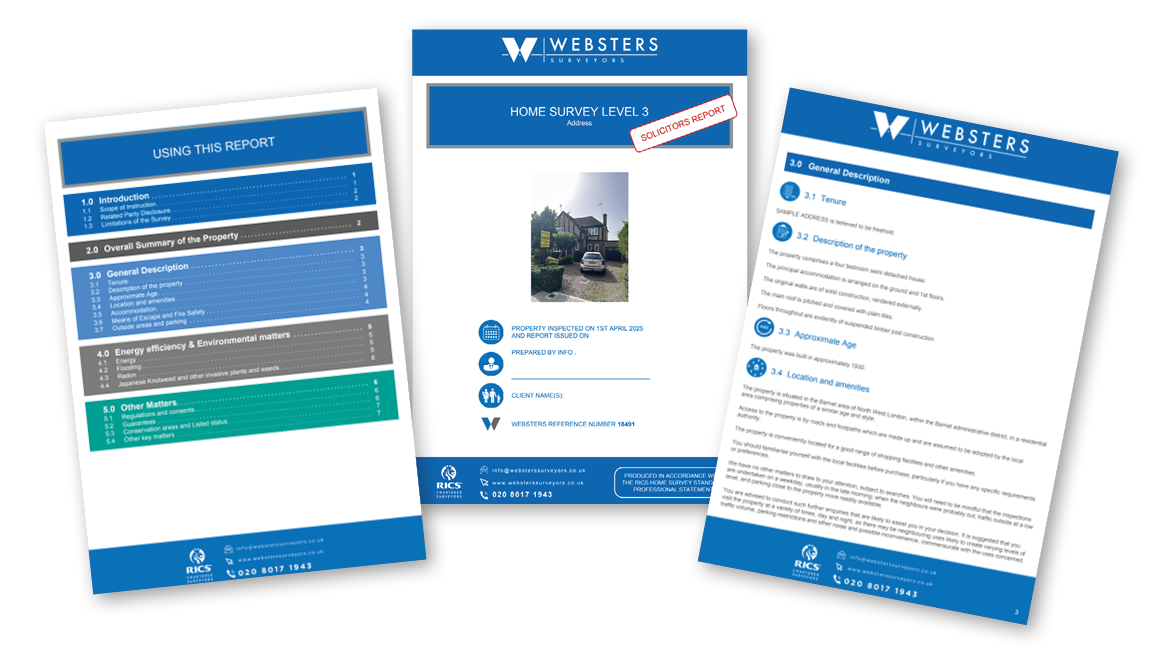
A summary report for your solicitor
We provide a complimentary solicitor's summary with every survey, written to help speed your purchase from an informed position.
About the solicitor's summaryOne size does not fit all
It's important to choose the right survey for the property and your own requirements. This table is based on the RICS information sheet, "Helping you choose the right survey".
| Service feature | Level 2 Surveyformerly HomeBuyer | Level 3 Surveyformerly Building / Structural |
|---|---|---|
| Describes the construction and condition on the date of inspection | ||
| Identifies problems that need urgent attention or are serious | ||
| Identifies things to investigate further to prevent serious damage | ||
| Tells you about problems that may be dangerous | ||
| Shows up potential issues and defects before a transaction takes place | ||
| Helps you decide whether you need extra advice before committing | ||
| Enables you to budget for repairs or restoration | ||
| Advises on ongoing maintenance required in future | ||
| Establishes how the property is built, what materials are used and how they'll perform | ||
| Describes visible defects, plus potential problems posed by hidden defects | ||
| Outlines repair options and a timeline, explaining the consequences of not acting | ||
| Provides specific comments on energy efficiency | ||
| Where practical and agreed beforehand, provides an estimate of repair costs |
Based on the RICS information sheet, "Helping you choose the right survey". Repair-cost estimates can be agreed in advance as an optional addition.

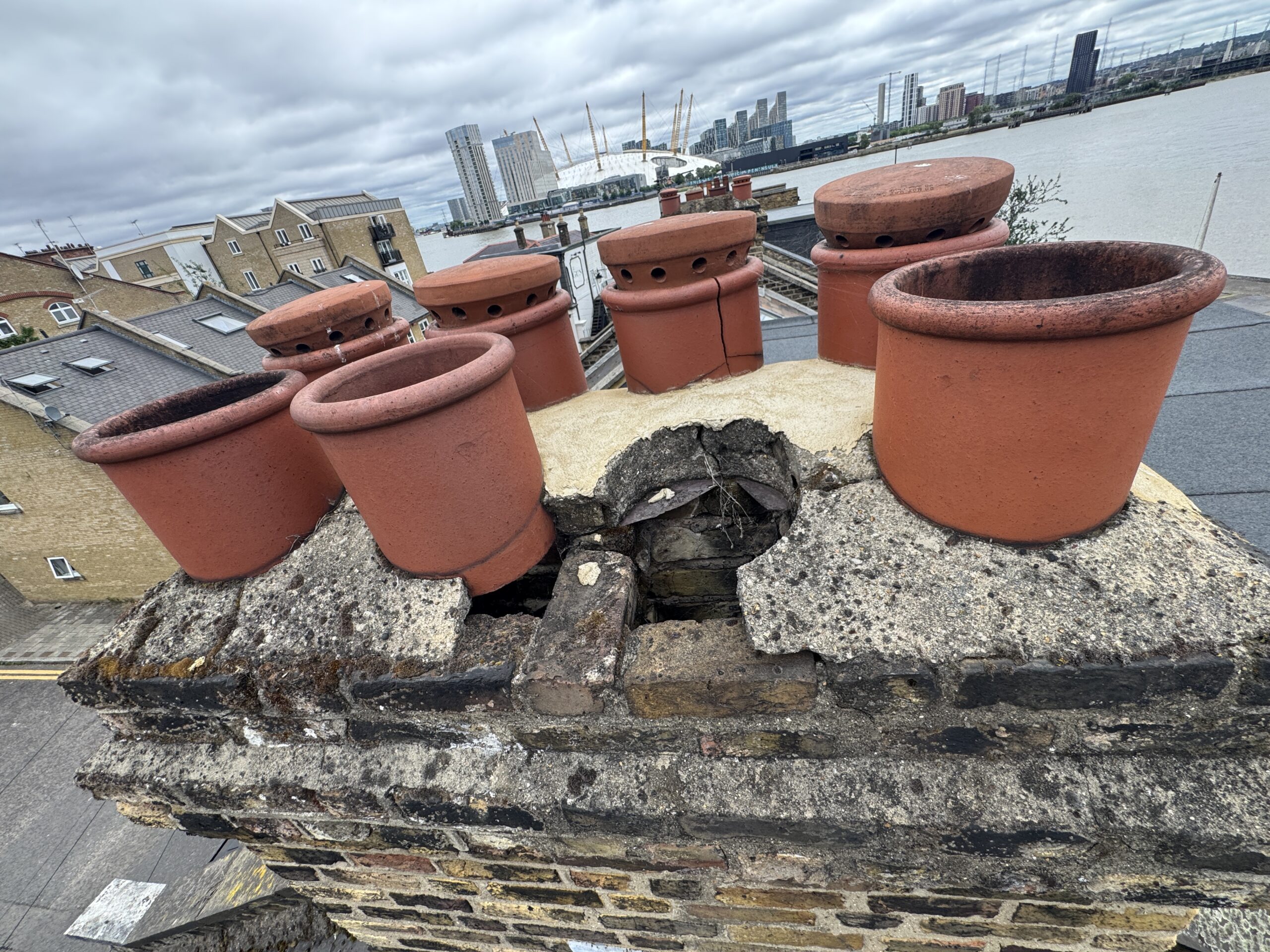
We see the defects ground level misses
Chimney stacks and high-level roof slopes hide some of the most serious defects — cracked pots, eroded flaunching, spalled brickwork and slipped tiles — yet they're the hardest areas to see from the ground. We fly drones to capture the stack, ridge, valleys and coverings, so problems are recorded, not guessed at.
- CAA-licensed, fully insured pilots — roofs and chimneys up to seven storeys
- Included on all surveys, Level 2 and Level 3, whenever weather and location allow
- Also invaluable for loft conversions, where the roofing framework is concealed
Add a valuation or insurance figure
With any Level 2 or Level 3 survey you can add an independent Market Valuation, a buildings reinstatement (insurance) figure, or both — separately, or combined at a discounted rate.
Independent Market Valuation
If you're buying with a mortgage, remember the lender's valuation is for them, not you — it assesses their lending risk, and you may never see a copy.
Our RICS Registered Valuers give you a Market Value figure based on comparable evidence and the property's own characteristics. Buyers often use it to renegotiate when the agreed price sits above our assessment.
Buildings reinstatement (rebuild) cost
Most UK homes are over- or under-insured. A reinstatement cost sets out the appropriate amount to insure the property for — often very different from the purchase price or market value.
Buying a flat? Buildings insurance is normally the freeholder's responsibility, so we don't provide a figure for an individual flat — but we can quote separately for the whole building if you need it.
Get ahead of your buyer's survey
Our reports are written for buyers — so commissioning one before you sell shows you exactly what a buyer's surveyor is likely to find. Deal with the issues on your own terms, protect your asking price, and go to market with nothing to be surprised by. It's the same RICS-regulated Level 2 and Level 3 reports, simply working for you instead of the buyer.
Level 2 from £650+VAT · Level 3 from £900+VAT · free Solicitor's Summary included
Why sellers survey first
- See what a buyer's surveyor sees, before they do
- Fix or price in issues on your terms
- Fewer renegotiations and fall-throughs
- Answer solicitor enquiries with confidence
Home surveys: frequently asked questions
Which home survey do I need — a Level 2 or a Level 3?
As a rule, choose a Level 2 for a conventional house or flat built from around the 1950s onwards that's in reasonable, well-maintained order, and a Level 3 for anything older, of unusual or non-traditional construction, visibly neglected, or significantly altered or extended.
The RICS Home Survey Standard sets the framework, and the real gap between the two is depth: a Level 2 confirms the property's condition and flags problems that are urgent or serious, while a Level 3 investigates how the building is put together and why a defect has happened — not just that it exists. If you're unsure which fits, we'll quote for both and explain the difference so you can decide on scope rather than guesswork. We'd rather you bought the right level than the dearest one, and where a property clearly warrants a Level 3, we'll say so plainly.
What does a Level 3 survey tell me that a Level 2 doesn't?
Quite a lot more — in both building terms and everyday-living terms. Beyond the Level 2's condition assessment, a Level 3 establishes how the property is built and how its materials will perform over time, exposes the hidden problems that visible defects often point to, sets out repair options with a timeline and the consequences of leaving things unaddressed, and comments specifically on energy efficiency.
Our Level 3 reports also go further than the RICS baseline on the practical things that shape daily life. We provide information on the mobile phone and broadband signal you can expect at the property, comment on local sources of noise pollution, and give fuller, more detailed guidance on the home's energy efficiency than a Level 2 — the kind of factors most buyers only discover after they've moved in, and which our Level 2 reports don't cover. For an older, extended or higher-value home, it's that combination of structural depth and liveability detail that usually justifies stepping up from a Level 2.
If I'm buying with a mortgage, do I still need my own survey?
Yes — the two things do completely different jobs. Your lender's valuation exists to protect the lender, not you. It assesses whether the property is adequate security for the loan, is often carried out with little or no internal inspection, and you may never even see a copy.
It is not a survey, and it won't tell you about the property's condition or the defects you'd be taking on. A home survey is commissioned by you, for you, by a surveyor who has inspected the property in person — and it's the only one of the two that sets out the property's true condition and the issues worth raising before you're committed. Treating the mortgage valuation as a survey is one of the more expensive mistakes a buyer can make.
When should I book a survey during the buying process?
As soon as your offer is accepted and you're reasonably confident the sale is proceeding — earlier than most people assume. Booking promptly matters because the survey often informs whether you proceed at all, and at what price; leaving it late can hold up your solicitor or push a finding past the point where renegotiation feels comfortable.
Our on-site inspection takes a few hours, a world away from the ten or twenty minutes of a typical viewing, and we usually issue the report about a week afterwards, followed by a call from the surveyor who carried it out. Building that into your timeline early keeps the purchase moving and means any serious finding surfaces while you still have room to act on it.
How much do your home surveys cost?
Our Level 2 surveys start from £650 + VAT and our Level 3 surveys from £900 + VAT, with every quote priced individually. The right fee depends on the property's size, age, construction and complexity, so instead of a flat rate we look at your specific property and give you a clear, bespoke figure with no surprises.
You can also add an independent Market Valuation, a buildings reinstatement (insurance rebuild) figure, or both, from £199 + VAT — taken separately or combined at a discount. Where a property could reasonably take either level, we'll quote for both so you can weigh the difference in scope and price side by side before you decide.
Can a survey help me renegotiate the purchase price?
Often, yes — and for many buyers it's where the survey pays for itself. When a report identifies defects that need attention, you have evidence to go back to the seller and ask for a reduction, or for works to be done before completion.
Buyers who add our independent Market Valuation use it the same way: where our assessed Market Value sits below the agreed price, that's a documented, RICS-backed basis for a conversation about the figure. The more thorough the survey, the stronger that position — a Level 3's detailed account of defects, repair priorities and likely consequences gives you far more to work with than a headline condition rating. We won't promise a particular outcome, but we'll give you the facts to negotiate from.
What makes a Websters survey different?
Our surveys are carried out by RICS-qualified surveyors who are also RICS Registered Valuers — so the person assessing the building can also speak to its value, which not every firm can offer. We deliberately keep volumes modest, around three to four surveys a week per surveyor, so each property gets unhurried attention.
Our surveyors are also CAA-licensed drone pilots, so we fly drones to inspect roofs and chimneys up to seven storeys; we include a complimentary solicitor's summary with every survey; and your surveyor calls you afterwards to talk the report through. And we don't upsell: where a Level 2 is right, we'll tell you, and where a property needs a Level 3, we'll be straight about that too. The aim is the right level of detail for your property — and full information in your hands before you're contractually committed.
Request a bespoke quote
Tell us about your property and we'll come back with a clear, fixed price — and explain the options so you can decide on scope, not guesswork. We'll also explain the optional valuation and insurance add-ons, and our drone aerial photography up to seven storeys.
Prefer to talk?020 8017 1943